
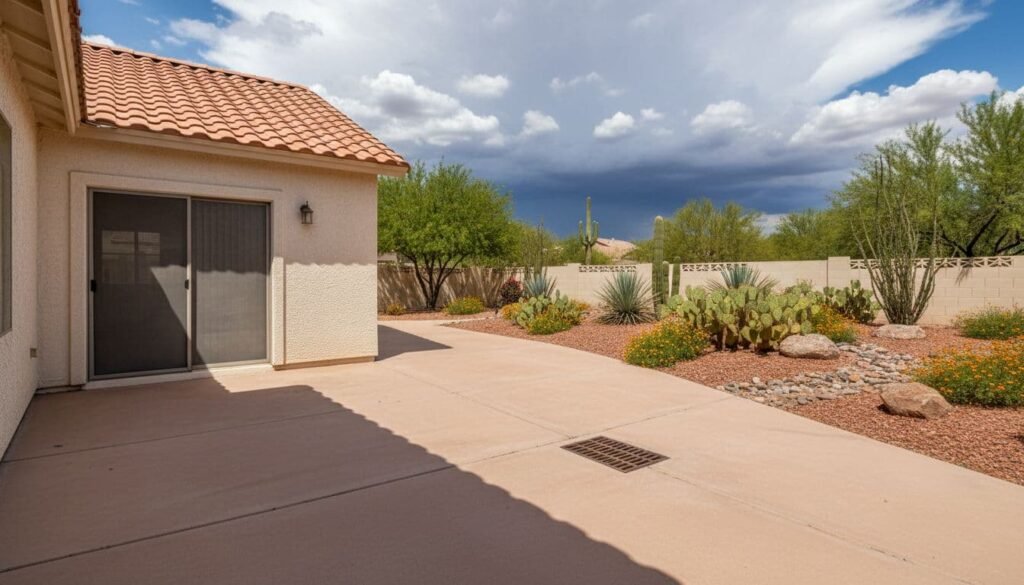
A flat patio looks “right” until the first real monsoon hits. Then it turns into a birdbath, pushing water toward your back door, stucco, and slab edge.
This patio slope guide is for Phoenix homeowners and DIYers who want contractor-grade results. You’ll learn the slope that drains fast, how to measure it with string lines or a laser, and how to keep drains working when dust and leaves show up at the worst time.
If you plan the pitch before the pour, the patio takes care of itself for years. If you need a professional instead, just reach out to us to schedule a free estimate.
Why patio pitch matters in Phoenix, AZ (more than you think)
In the Valley, rain is usually light, until it isn’t. Monsoon storms can dump a lot of water in minutes. When that water lands on concrete, it has only two choices: run off or sit and pool.
Sitting water causes problems fast:
- It finds the low spot near the house and stays there.
- It carries silt and roof grit, making ugly stains.
- It seeps into joints and edges, then leaves behind salts.
- It feeds mosquitoes and makes your patio slick.
Phoenix heat also works against you. Concrete expands in extreme sun, then cools at night. Any weak edge, poor base compaction, or low spot becomes more obvious over time. Pitch is cheap insurance.
See our service pages for patios, slabs, and driveways for more information and to schedule a consultation if this project is too big for you to tackle. Getting the prep right the first time is extremely important when working with concrete.
Recommended concrete patio slope: 1/4 inch per foot is the safe bet
A good target for Phoenix is simple:
- Preferred slope: 1/4 inch per foot (2%)
- Bare minimum: 1/8 inch per foot (1%), only when runoff is easy and finishes are true
Why push for 1/4 inch per foot? Because monsoon runoff is intense, and patios are rarely perfect. A broom finish, stamped texture, and normal finishing variance can hide shallow dips that hold water. A little extra pitch gives you tolerance.
Many builders and inspectors point to IRC guidance for hard surfaces near foundations. The Building America Solution Center summarizes the common expectation that slabs and flatwork within 10 feet should slope away from the house (often treated as 2%). See Building America’s guide on sloping slabs away from the house. For a plain-language code discussion, see this overview referencing IRC R401.3 slope.
Quick drop table (common patio sizes)
| Patio length (ft) | Drop at 1/8 in/ft | Drop at 1/4 in/ft |
|---|---|---|
| 6 | 3/4 in | 1 1/2 in |
| 8 | 1 in | 2 in |
| 10 | 1 1/4 in | 2 1/2 in |
| 12 | 1 1/2 in | 3 in |
| 15 | 1 7/8 in | 3 3/4 in |
| 20 | 2 1/2 in | 5 in |
As a comfort limit, most patios feel best under about 4% slope (1/2 inch per foot). Beyond that, chairs wobble, and runoff can erode the yard edge.
Plan where the water goes (drains, overflow paths, and debris)
Slope is only half the job. You also need a “landing zone” for water that won’t back up when debris hits.
Common patio drainage setups in Phoenix:
Single-plane slope away from the house: The simplest option. Water runs from the house edge to the yard edge.
Two-plane slope to one side: Useful when you can’t dump water across the full yard edge. This works well with a side swale.
Channel drain at the low edge: Great when walls, planters, or pool decking trap water. It needs a clean outlet to daylight or an approved drain route.
Monsoon reality: the first storm often drags dust, palo verde pods, gravel, and leaf litter. That can clog a drain grate fast. Use removable grates, add a cleanout point, and keep an overflow path (a low spot that sends water to a safe area if the drain clogs).
If you’re starting from an old, poorly sloped slab, removal and regrading might be the cleanest fix.
How to set the pitch (string line or laser, batter boards, screed guides)
This is the part that separates a patio that drains from one that “almost drains.”
- Pick your high point at the house. Set patio height to protect the wall. Maintain clearance from stucco and any wood trim. If you have stucco, keep clearance in mind around the weep screed area.
- Choose the slope rate. For monsoons, use 1/4 inch per foot when possible. Write the math on a notepad before you start.
- Set batter boards. Place them beyond the patio corners so forms don’t bump them. They’re your fixed reference.
- Run string lines for elevation. Stretch a level string at the house side to mark the high edge. Then pull a second string at the low edge, set lower by the total drop (example: 10 ft run at 1/4 in/ft equals 2.5 inches).
- Check elevations with a laser level (or a line level). A rotary or cross-line laser makes this faster and more accurate. Verify both corners match your intended pitch. Don’t trust your eye.
- Build forms to the strings. Set the form top at the same elevation as your strings. Double-check for bows, because the slab will follow the form.
- Install screed guides. Set pipe, angle iron, or straight 2×4 screed rails at the same slope. This helps you strike off consistently, even if you’re new to finishing.
- Verify drainage before the pour. Walk the forms and imagine water flow. If a wall, step, or planter blocks runoff, add a drain now, not later.
Concrete details that protect the patio and the house
Slope won’t save a patio if the edge and joints are wrong.
Isolation at the house: Use an expansion or isolation joint where the slab meets the stem wall. That reduces stress and helps keep water from wicking at the connection.
Control joints: Plan joints so cracks happen on your lines, not randomly. In Phoenix heat, shrinkage happens fast.
Base and compaction: A well-compacted base helps the slab hold its grade. Poor compaction leads to settlement, and settlement steals your slope.
The most common patio slope mistakes (seen all over the Valley)
- Back-pitch toward the house from bad form setting or a rushed screed.
- “Birdbaths” caused by low spots near posts, corners, or stamped mats.
- Drain with no outlet, or a drain that clogs because the grate is too fine.
- No overflow path, so a clogged drain floods the same spot every time.
Think of water like a shopping cart on a slight hill. It always finds the easiest path, even if you didn’t plan one.
Neighbors, HOA rules, and local checks (no legal advice)
Don’t aim runoff at a property line or side gate and hope it disappears. It can create real problems fast, especially during heavy storms.
Before you pour, it’s smart to:
- Check HOA guidelines for hardscape changes and drainage expectations.
- Confirm whether your city requires permits for your patio scope and drainage changes.
If you’re unsure, ask your local building department or a qualified pro. This is practical planning, not legal advice.
Conclusion: set the pitch once, avoid problems for years
A patio should shed water like a roof, just slower. In Phoenix, 1/4 inch per foot is a reliable target for monsoon runoff, and careful layout keeps it true. Plan debris, drains, and an overflow path, because storms don’t arrive clean. Set your lines, set your forms, and your slab will follow.
If your yard layout makes drainage tricky, don’t guess. A small change in grade today can prevent a big repair later.